Fishing News
Francois Hollande, the newly elected president of France, has been warned that he and his government must show “political courage” in their approach to protecting the seas.
The new government has still to announce its position on the proposed reforms of Europe’s Common Fisheries Policy (CFP) but it was issued a clear challenge by award-winning French actress Melanie Laurent that change and action are needed.
Ms Laurent provides the voice-over for the French version of The End of the Line and in a message read out at a preview screening of the film in Paris she expressed a hope that the practices and policies that have enabled widespread overfishing to take place around Europe will be ended.
“This film is the most important of your life,” she said. “I hope it will lead you to change your habits. It takes political courage to take the necessary decisions. Acting is the only solution.”

Actress Melanie Laurent is providing the voice-over for the French version of the film
Following the special screening at the Lincoln cinema in Paris, members of the invited audience took part in a debate on how fisheries are managed and what needs to be done, including reform ofthe CFP.
Francois Chartier, an oceans campaigner for Greenpeace, said: “The new government will be judged on its ambition, yet it is in terms of its positions on fundamental issues like the European Common Fisheries Policy (CFP) that this ambition will be evaluated.” He was especially concerned that M Hollande and his government listen to the scientists on what actions are needed to protect marine stocks rather than vested interests.
“Each point of the CFP must be assessed in line with scientific predictions and the needs of the natural world, and not just in response to the lobbying of the fishing industry.”
Ghislain Ghomart, of the Grenelle Environment forum, backed calls for more pressure to be put on the French government to accept reform of the CFP. He was especially concerned that politicians put an end to fishing subsidies and deep sea fishing where slow-growing stocks such as orange roughy have been devastated. He also advocated the creation of marine reserves as a means of protecting fish and other marine wildlife. Charles Clover, author of the book behind the film, called on consumers to change their seafood eating habits to encourage the sale of sustainably sourced species in restaurants and shops. By doing so, he said, consumers would force the fishing industry to fish more sustainably. He said: “Consumption habits can be altered and therefore the fishing industry will be forced to respond by managing fisheries more sustainably. It is up to us, the consumers, to demand that our fish comes from sustainable fisheries.”
Speaking at the event, he announced that more than 70 of the UK and Europe’s top chefs, including several with Michelin stars, have signed up to a series of demands organised by Fish2fork - a legacy project of TEOTL - that Europe’s political leaders push through radical reforms of the CFP.
Among the demands are that discards are halted, quotas are based on scientific assessments of what fish stocks can stand rather than what the fishing lobby can squeeze out of politicians, better labelling is introduced, and that fisheries be managed sustainably.
Chefs who have signed up to the demands include Hugh Fearnley Whittingstall, who organised the Fish Fight campaign against discards, and Jamie Oliver.
The French version of The End of the Line will be released on June 6 in time for World Oceans Day and on DVD on June 18.

The End of the Line, Fish 2 Fork and the Blue Marine Foundation team are still on a high after winning the first ever PUMA Creative Impact Award. Current TV will be screening the Award in their show Docs That Changed The World on Saturday 22 October at 9pm which features interviews with The End of the Line team after winning the award.
Current TV will then broadcast The End of the Line at 9.30pm which will be repeated Sunday 23 October at 10.30pm.
The show features interviews with the finalist filmmakers (The Age of Stupid, Burma VJ, End of the Line, The Reckoning, Trouble the Water) and the jury, including Queen Noor of Jordan and Morgan Spurlock, as well as coverage and commentary from the ceremony itself.
This annual €50,000 award, a first of its kind in the industry, has been launched to identify and honour the documentary films that have made the most significant positive impact on society.
You can watch both the PUMA Creative Impact Awards and The End of the Line on Virgin 155 Sky 183.
The End of the Line has won one of the film world’s most valuable awards after being hailed for bringing about real change in its efforts to stop the oceans being emptied of fish. It was announced the winner of the inaugural Puma Creative Impact Award at a ceremony in Central London, beating off stiff competition from Burma VJ: Reporting from a Closed Country and The Age of Stupid.
The End of the Line, directed by Rupert Murray, features Charles Clover, the investigative journalist, as he chronicles the catastrophic decline of global fish stocks, challenging politicians and restaurateurs along the way.
The Puma award judges, including Queen Noor of Jordan, Morgan Spurlock, the director of Super Size Me, were impressed both by the immediate impact of the documentary and its long-term social influence.
Jon Snow said he was “not surprised” The End of the Line had been named the overall winner. The documentary had “completely transformed the way a very large number of people think about fish”, he added. “You can see restaurants and supermarkets changing their ways because of what their customers now know,” Snow told BBC News.
Snow who hosted the award ceremony, paid tribute to the film’s achievements in persuading companies like Pret a Manger and Whiskas cat food to change their fish-buying policies to reduce the damage to the world’s fisheries, and in helping to create a charity that with the Chagos Islands initiative has doubled the area of the oceans protected as marine reserves from one to two per cent.Fish2fork, the campaigning sustainable restaurant guide, and the Blue Marine Foundation, which led the campaign to create a marine reserve around the Chagos Islands, are among the legacies of the film and continue to draw public attention to the state of the world’s fisheries and in finding ways to bring about improvements.
A recent study by the Channel 4 Britdoc Foundation, which partnered Puma Creative in holding the awards, concluded earlier this that by the spring of 2010 a total of 4.7 million people in the UK were aware of the documentary. The linkup between Fish2fork and Selfridges to run the Project Ocean campaign in the West End of London this year was another factor in the film winning the award and the £43,000 (€50,000) first prize.
A delighted Mr Murray said winning was “brilliant” and said it was “really an award for everyone” who was involved in making the film. He described the win as the “icing on the cake” to making a film that had succeeded in changing people’s ideas about fish and fishing. He added: “Documentary film makers aren’t just concerned with making films for entertainment. There’s a purpose behind it. This award recognises that desire to make a positive impact on the world.” Queen Noor and Mr Spurlock were joined on the judging panel by Orlando Bagwell, the Emmy award-winning filmmaker, Loretta Minghella, the director of Christian Aid, and Emmanuel Jal, the musician and social campaigner.
They said in announcing The End of the Line as the winner: “We all agreed that the prize should go to the film that was most beautifully crafted, that carried a message of global importance, that delivered a call to action that must be heeded, that delivered on that call to action to create actual awareness and, as the award suggests, impact. “It is for this reason that the 2011 PUMA Creative Impact Award goes to a movie that stays with you long after the credits have rolled. It is a film that has and will continue to influence and shape the actions of individuals, the choices of governments, of the media, and of industry. Hopefully with this prize, the great work that has begun can continue.”
Mr Clover, whose book The End of the Line was the inspiration for the documentary, said: “I would like to pay tribute to Rupert Murray, Claire Lewis, Claire Furguson, the creative people who took my book and made a film out of it. They made a film that makes people feel as angry about what is happening to the sea as my book did. I’d like to thank in particular Christo Hird, our executive producer, who saw the potential social impact all along and helped us to achieve it beyond our wildest dreams.
Clover continues “Our two legacy projects of the film, the Blue Marine Foundation - founded by two other producers of the film, Chris Gorell Barnes and George Duffield - and Fish2fork could not have come into being without the whole team making the film as good as it was.”
“Jochen Zeitz, chairman of the board at Puma, the sportswear company, said: “Documentary film is such an influential medium because it allows the public to emotionally connet with the subject matter. We hope that with the PUMA.Creative Impact award we can help to inspire positive change in the world.” The End of the Line was on a shortlist of five documentaries. Burma VJ came second with a special commendation from the judges. The Age of Stupid, Trouble the Water and The Reckoning: The Battle for the International Criminal Court were the other shortlisted films.
From the Seafood Summit in Paris last week, where we were all agog for news of a shift in the French position on bluefin which only happened after we left, I flew to New York for a screening of The End of the Line at the UN General Assembly, organised by the Deep Sea Conservation Coalition. This screening was arranged to co-incide with a UN working group reviewing the effectiveness of UN resolution 61/105 passed four years ago that called on states and regional fisheries managers to protect vulnerable marine ecosystems such as sea mounts from deep-sea trawling.
The screening of a 25-minute version of the film was well attended, with some 80 or so diplomats and experts filling the delegates dining room for the screening, Q&A and reception hosted by DSCC. As you can imagine, there were some searching questions, for instance “What can the UN do about over-fishing?” and “What is the attitude to sustainability in Japan?” I attempted an answer and about 50 people departed with a copy of the book on which the film is based.
The audience was greatly fascinated by the announcement, at last, by two French ministers that day, of the French position on bluefin tuna – support for an Appendix 1 listing, a full international trade ban, but with an 18-month delay.
It seemed timely for us, the film-makers, Oceana and Greenpeace to put out a release relevant to the United States, so we pointed out, what few US consumers seem to know, which is that imports of endangered bluefin tuna into the United States for the sushi trade are contributing to the collapse of the population in the Mediterranean and Eastern Atlantic. The bluefin that finds its way on to the menus of the New York and LA restaurants that have such poor ratings for sustainability on www.fish2fork.com is more likely to have come from the Med than the US. Official export figures from the European Union, compiled by Roberto Mielgo, one of the major players in our film, show that up to 3,341 tons of bluefin was exported from the EU to the United States between 1998 and June last year. In 2008 the US was a net importer of bluefin, importing 360 metric tons from around the world, notably the Mediterranean, compared with the 266 metric tons that were caught domestically. Such is the value of bluefin - nearly $9 a pound on average - that the total trade in the United States is worth nearly $100 million a year.
I returned to England to hear that frenzied briefings were going on in Strasbourg ahead of a crucial vote in the European Parliament on whether the EU should support Cites Appendix 1 for the bluefin. MEPs came under heavy lobbying pressure from DG Fish which told them that an Appendix 1 listing was an incredibly dangerous precedent to set and might one day be applied to the cod. What disgraceful nonsense. MEPs also had their ears ringing with briefings from the European fisheries inspectorate saying they had the fishery screwed down and could police an 8,000 tons a year sustainable quota imposed under Cites Appendix II, which regulates but does not stop trade. There was a rocky moment for our campaign to save the bluefin when it looked as though this advice would prevail. Then, MEPs realized that the EU was not the only player in the bluefin game and that Turkey, Libya, Croatia, Algeria and the Japanese long-liners in the Atlantic were quite capable of wiping out the bluefin on their own if the Japanese market was not closed. Wise counsel prevailed and a majority of MEPs voted to place the bluefin on Cites Appendix 1, without the 18-month delay called for by France. This will make it difficult for DG Fish, or the Commission, to resist pressure to do the same. The same day as the vote, Italy finally declared for Appendix 1, making it inessential that the conditions imposed by France should apply. The fishing lobby was furious. It is looking more and more as though the EU’s 27 member states might actually go to Doha supporting Appendix 1 for the bluefin. Fingers crossed!
Charles Clover
New York
A worldwide ban on the trade in the endangered bluefin tuna has moved a step closer after France pledged its support.

Bluefin tuna for sale at a fish market in Japan
In a significant move the French said they would support the listing of bluefin tuna under appendix 1 of the Convention on International Trade in Endangered Species (CITES) but with conditions.
French environment minister Jean-Louis Borloo and fisheries minister Bruno Le Maire said they want an 18-month delay before the measures come into force. In return for its support France is also likely to seek an exclusive fishing zone for line-caught tuna as well as financial aid to retrain fishermen who are likely to be laid off.
This will be seen as a sop to the powerful French fishing lobby which has threatened blockades if the ban is imposed. The fishermen’s leaders are also seeking an urgent meeting with French President Nicolas Sarkozy. Continue reading ‘Bluefin tuna ban: France pledges support for CITES listing’
A crucial vote on whether Europe will back a trade ban on the critically-endangered bluefin tuna is expected to be taken on Tuesday.
In advance of the event, the makers of the film The End of the Line, which focuses on the over-fishing of the bluefin tuna in the Mediterranean, have sent an appeal to all 27 European Commissoners asking for them to watch the film and reflect carefully before making their decision. Continue reading ‘The End of the Line used in appeal to European Commission as crucial vote nears’
Copenhagen
As I dashed through the snow from the chaos around the COP15 climate conference to a screening of The End of the Line near the Town Hall in this lovely city, the phone went and I learned that European Ministers have done the right thing, arguably for the first time, in the annual talks over fish quotas, a story that might make headlines if it was not overshadowed by the climate talks.
They approved quotas based on scientific advice on North Sea cod, plaice and sole without discussion - instead of setting them at significantly more than scientists recommended as so often in recent years.
They also decided to ban fishing for the critically endangered porbeagle shark and cut allowable catches for the equally endangered spurdog.
What has come over them? Well partly it may have to do with an unprecedented spat with Norway over quotas, which will mean that these cannot be finalised until the New Year.
But I am also told that advisers have woken up to the fact that none of the major processers and retailers such as Birds Eye and Youngs are buying the North Sea cod because it is not being harvested sustainably.
Progressive ministers in Denmark, Germany and the UK have realised that the industry faces an uncertain future, and lower prices, unless it can sell its product across the whole market and this is behind the decision to bite the bullet, follow the scientific advice and manage the fishery properly. This is not before time, but to be applauded.
Could this have had anything to do with the fact that The End of the Line has been screened recently in all those countries?
Well, probably not directly, but indirectly the message that we in Europe can’t go on managing our seas like this seems to be getting through.
Bluefin tuna - sometimes you just can’t believe how absurd the story gets.

Raul Romeva i Rueda and Charles Clover at ICCAT
News from WWF and a Green MEP show that over an eight-year period the EU bluefin tuna fishing industry received subsidies totalling €34.5m.
Yes folks, your tax helped fund the overfishing of a species now teetering on the very brink of extinction. A species that 21 out of 27 EU countries now think should be subject to an international trade ban.
Raül Romeva i Rueda, a Spanish Green MEP, received answers to parliamentary questions revealing the extent of subsidies which took place between 2000 and 2008.
Of the €34.5m total, some €33.5m was for the construction and modernisation of fishing vessels, and only a tiny proportion (€1m) for decommissioning boats.
These revelations come as the EU Commission and member states have to start readdressing their own thoughts on Atlantic bluefin. Last month’s ICCAT meeting in Brazil failed to close the fishery, and saw EU negotiators (led by France and Spain) pushing for the highest possible quotas.
This in itself was hypocrisy after three-quarters of EU member states had voted to support an international ban on the species - showing just how disproportionately powerful the lobby of the Mediterranean fishing nations is.
These new revelations make the whole EU bluefin story even more difficult to swallow, since the already lucrative trade in bluefin (which has escalated despite scientific warnings) has been made even more profitable with taxpayers’ money. And it’s not even as if the subsidies were targeted at supporting traditional or lower-impact methods of fishing - they also applied to the massive purse-seiners.
The beneficiaries of the money were Cyprus, France, Greece, Italy, Malta and Spain. In an amazing coincidence the six EU member states which blocked support for an international trade ban were Cyprus, France, Greece, Italy, Malta and Spain.
It really makes you wonder what the 21 other EU countries are getting out of this arrangement… and what exactly they will do next? The EU must come up with an agreed common position before the CITES meeting in March 2010.
Many countries like the UK have already publicly supported a full trade ban. This new illustration of just
how the countries blocking effective measures to protect this species are being subsidised to trash the species can surely only strengthen the case for such a ban.
As ICCAT souvenirs, delegates will be packing their bags in Recife with a delightful polo shirt emblazoned with ‘ICCAT’ and a bluefin tuna, and a pair of flip-flops in Brazilian colours.
Somehow this is quite fitting.
The meeting has just come to a close, and the rushed final sessions have agreed as much as they could. In that haste, several things were put off to be considered again next year.
Like the protection of endangered mako and porbeagle sharks, and measures to reduce the bycatch of seabirds and turtles. These sorts of delays are common in ICCAT when agreements can’t be reached. But hey, why do today, what you can put off until next year, right?
But the true legacy of this meeting will be the discussions on bluefin tuna. Much of that discussion clearly happened behind closed doors, with the open sessions us mere observers get to see being something of a rehearsed pantomime for some members.
On the final day a proposal came forward for a quota of bluefin tuna (for the Mediterranean and East Atlantic) for 13-and-a-half thousand tonnes for 2010. That could only have been more unlucky if they’d come forward with it two days earlier, on Friday 13th. It marked a huge drop in quota, and for the first time the bluefin quota was set *within* scientific recommendations.
It’s just a shame they ignored the recent updated scientific recommendations and used last year’s instead. For just three weeks ago, ICCAT’s own scientists showed that not only did Atlantic bluefin meet the criteria to be listed under CITES for a trade ban, but also showed that only a quota as low as 8,000 tonnes would show any chance for the stocks to recover at all. Unsurprisingly the best option for rebuilding the stock was zero quota. All of this meant that the only credible thing ICCAT could do was close the fishery.
They have failed to do that. So perhaps the polo shirts are meant as a commemorative epitaph for a species ICCAT has given up on. In the words of one delegate who was pushing for the fishery to be closed ‘I would like to bid farewell to our good friend, bluefin’.
And the flip flops? Well ‘flip-flop’ was famously used to describe a Presidential candidate in the US for changing his mind, repeatedly. So the question has to be – where now for all of those countries who have stood up and called for effective action on bluefin, or even publicly backed a trade ban? 21 out of 27 EU member states, including the UK and France have done that (although it seems Sarkozy may have already flipped). And does the United States really think that ICCAT has done enough to protect Atlantic bluefin?
If you ask a country’s representative here you will get a stock answer along the lines of ‘oh someone else deals with that’, because fisheries and environment departments are usually conveniently partitioned. So who is going to flip-flop now on bluefin tuna? Can the ICCAT participants put their hand on their hearts (which, conveniently is just where the bluefin is on the polo shirts) and say they’ve done enough here this week?
I don’t think so. The panicked agreements are all about this organisation doing whatever it could to avoid CITES listing, a point that was referred to again and again by interventions around the table. CITES will meet in March 2010, and they may well free up ICCAT’s agenda next year if they do agree an international trade ban, as they desperately need to.
As we now bid farewell to Brazil, we are tempted to do more than just wave our flip-flops on the way out of the meeting.
Let’s be absolutely clear. The people whose task it is to manage the bluefin tuna stocks of the Atlantic have failed once again, even under the eyes of the world, to take the advice of their own scientists. They should now be brushed aside.
The Atlantic tuna commission, meeting in Porto de Galinhas, Brazil, has agreed a proposal to drop the catch limit for bluefin tuna in the Eastern Atlantic and the Mediterranean next year from 19,500 tons to 13,500 tons.
I was at the meeting and interviewed the chief scientist of the commission, Dr Gerald P Scott and he told me that in the present uncertain state of bluefin stocks – which in layman’s terms are in a state of collapse - 15,000 tons doesn’t meet the commission’s recovery plan which looks for a 50 per cent chance of recovery by 2023.
The paper Dr Scott showed to the meeting showed that only a 8500 ton quota might have a chance of meeting the commission’s remarkably weak objective for recovery. Only a total closure of the fishery yielded a significant chance of the bluefin recovering from a serious threat of commercial extinction.
So the proposal for a 13,500 ton quota by the chairman of the meeting, supported by the EU, Japan, Morocco and Tunisia, is a political quota, not a scientific one. It is far too high. No wonder the United States did not support it. No wonder the environmentalists are portraying it as a failure. The only silver lining is that this decision could, just conceivably, lead to the management of the bluefin being taken away from the tuna commission.
Susan Lieberman of the Pew Environment Group, a US-based not-for-profit organisation, responded to the news by saying: “When you adjust the new catch limit to account for over-fishing and rampant illegal fishing by some countries and add in ICCAT’s poor enforcement and compliance record, the prospects for the recovery of the once-abundant Atlantic bluefin are dismal.”
No one is that surprised, though. For it has turned out that the International Commission for the Conservation of Atlantic Tunas (ICCAT) was mis-named, for it has never once taken scientific advice literally in its 40-year history as you will see from my article in the Sunday Times.
The result of the meeting is now likely to increase demands for international trade in bluefin to be banned by being listed on Appendix 1 of the Convention on International Trade in Endangered Species (CITES), the same provision that was used to save the African elephant in the 1980s after an epidemic of ivory poaching.
The EU was unable to agree to support such a listing in September, with the six Mediterranean nations forming a blocking minority and 21 nations in favour. That decision is likely to have to be formally revisited now before the CITES meeting in Doha next March.
The ICCAT meeting formally identified nearly all the countries catching bluefin for breaking the rules – a new thing – one of the most common infringements was tuna fattening farms accepting fish without proper documentation to show that they had been legally caught.
Despite a week spent at the five-star resort, delegates were unable to agree on measures to protect vulnerable shark species. They did agree to ban the retention and landing of bigeye threshers, one of the slowest growing and most vulnerable sharks, but allowed Mexico an exemption to catch 110 of them. They put off until next year any consideration of measures to prevent 12,500 vulnerable seabirds being caught by tuna long-line fleets.
In a further instance of what environmentalists were portraying as overall failure, officials among the Atlantic nations endorsed the use of “wall of death” drift nets by Morocco for another two years.
Moroccan fishermen are estimated to kill 4,000 dolphins and 25,000 sharks in their drift nets each year. Drift nets have been banned internationally by the UN since 1992.
Dr Sergi Tudela of the environmental group, WWF, said: “This year all contracting parties talked of the need to restore ICCAT’s credibility, and to do so they endorse the slaughter of 50,000 more sharks and 8,000 more dolphins, violating UN resolutions?
“It is beyond belief and is one more proof of the total dysfunction of ICCAT as a serious fisheries management organisation.”
No comment was available from the ICCAT contracting parties or the European Commission last night on the decisions made at the meeting.
So, here in Brazil, the game is on. At the end of yesterday’s session the parties around the table at the ICCAT meeting were asked what their priorities were for conserving bluefin tuna.
One by one they made positive murmurings about wanting to ‘follow the scientific recommendations’, and enforce compliance with them. They all pretty much said they want to see illegal fishing tackled.
No rocket science there, and you would be forgiven for wondering why they have not done those things already!
More importantly there were also some hints as to how low some countries would go in terms of a quota, with several actually suggesting the possibility of closing the fishery. To you and me that may be a no-brainer. To many of them, it is a seismic shift.
Now, we shouldn’t get ahead of ourselves here. There is a lot of horse-trading to be done behind closed stable doors. And it’s worth noting that the talk about closing the fishery is just for one year – which could well be a very convenient way of avoiding bluefin being subject to an international trade ban under CITES.
Greenpeace, and other conservation organisations here, won’t settle for that – and we are reminding the participants at ICCAT that the only credible thing they can do is close this fishery.
And it seems they desperately want to regain some credibility here. You can understand that, after all ICCAT was branded an ‘international disgrace’ by an independent review.
The spotlight is on them because of what they have allowed to happen to bluefin, and the bureaucrats who attend these meetings really don’t like that. Delegate after delegate has talked about the need for ICCAT to claw back credibility, conveniently ignoring that this is a situation their own bad judgement in the past has got them into.
From an observer’s point of view here there is much to be cynical about. This is a dysfunctional meeting in a tropical paradise, at a resort whose very construction has caused disruption and problems for the local coastline in Brazil, with gala dinners, cocktail receptions, and a self-congratulating bunch of faceless bureaucrats mismanaging species, fisheries, and livelihoods.
Yesterday was an eye opener, with some impassioned and stirring interventions (particularly from some of the African delegations) requesting stronger action to protect stocks of fish in their waters.
At several points I wanted to stand up, cheer and applaud. But those heartfelt pleas were met by some cynical process point-scoring by delegations on the other side of the table, immediately filling me with despair.
There is still a long way to go here.
- Willie MacKenzie is part of Greenpeace’s Ocean Campaign. This blog post originally appeared on the Greenpeace UK website.
The End of the Line was shown in remarkable circumstances this week – in the official convention hall of a hotel near Recife, Brazil, where the world’s oldest whole-ocean fisheries management organisation was meeting to set controversial catch limits for the Atlantic’s dwindling populations of tuna, swordfish and sharks.
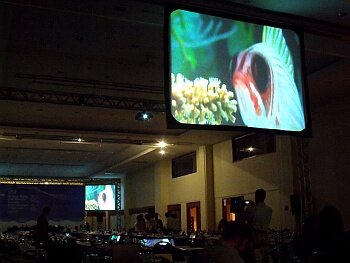
The End of the Line is shown at the International Commission for the Conservation of Atlantic Tunas meeting in Brazil
It took a certain amount of persuasion. It needed the crucial backing of the Brazilian chairman of the meeting, Prof Fabio Hazin (the curiosity of these meetings is that the chairmen are usually enlightened while the contracting parties from the fishing nations, which include Libya, are anything but).
It also needed a mysterious process of agreement from heads of delegations sitting in closed session.
The chief scientist, Dr Gerald P Scott, an American, was consulted, and pronounced in a neutral kind of way that the idea of showing a film, after and outside the official business of the day, was something that had been done before - though quite when nobody could remember - and might provide an opportunity some delegates might not otherwise get to see it. The film was duly shown in the convention centre, on official equipment.
Was this a sign that the dysfunctional International Commission for the Conservation of Atlantic Tunas – often known to its critics as the International Conspiracy for Catching All The Tuna – was at last beginning to listen to voices outside the fishing industry, such as the citizens who actually pay them to manage the sea? No one could say for sure.
About 40 people postponed their need for a beer or managed to slip out of meetings to see the film. Some of these, inevitably, were the already converted: conservationists who were seeing the film as an act of solidarity with its message.
Two Asian delegations stood around talking before filing out. But here and there, as you looked around, were some senior delegation folk sitting in small groups including, significantly, most of the Spanish delegation. At the end, there was applause.
We were approached the next night by the secretariat requesting a second screening for delegations, principally Mexico, that had missed the screening we had organised because of meetings. So we were back by popular demand.
Could the message be getting out that our seas are a mess and ICCAT has failed for 40 years to tackle the problem of the depleting Atlantic ocean?
Whether or not this was a sign of changing times, for once this week the message got through.
Ends
Scientists say the population of Atlantic bluefin tuna has crashed so low that an immediate ban on international trade in the species is justified.
Scientists from the International Commission for the Conservation of Atlantic Tunas (ICCAT) said that spawning stocks of bluefin have fallen below 15 per cent of what they were historically on both sides of the Atlantic.
Their analysis said that that a suspension of commercial fishing was the only measure which would take the bluefin – which has become the symbol for many of European and Atlantic nations’ failure to manage their fisheries - out of the category of qualifying for a trade ban within a decade.
The scientists met in Madrid, Spain from Oct 21-23 to assess current stock status of Atlantic bluefin tuna against the specific criteria necessary to list a species under Appendix I of the Convention on International Trade in Endangered Species (CITES) – which would trigger a trade ban.
Earlier this month, the Principality of Monaco submitted a CITES Appendix I listing proposal to temporarily ban international commercial trade and allow the species to recover from years of ineffective fisheries management and control.
The official assessment of bluefin’s extreme stock decline was welcomed by the environment groups WWF, Greenpeace and the Pew Environment Group.
“What’s needed to save the stocks is a suspension of fishing activity and a suspension of international commercial trade – this is the only possible package that can give this fish a chance to recover,” said Dr Sergi Tudela, head of fisheries at WWF Mediterranean.
“We must stop mercilessly exploiting this fragile natural resource until stocks show clear signs of rebound and until sustainable management and control measures are firmly put in place.”
“The ICCAT scientists have made formal what we have been saying all along – that Atlantic bluefin tuna is balancing precariously on the edge of collapse, and only drastic measures can now ensure this endangered species gets a fighting chance of recovery,” added Sebastian Losada of Greenpeace International.
“The extent of the failure by ICCAT members to act responsibly and preserve our marine environment can no longer be ignored.”
The verdict of the scientists will be submitted to ICCAT nations who will decide whether they will support an immediate trade ban or whether they will grant a quota for next year at their meeting next month in Recife, Brazil.
“Independent of what ICCAT decides to do in November, the science is undeniable that Atlantic bluefin tuna meets the criteria for a suspension of trade through a CITES Appendix I listing – and if ICCAT stops the fishing too, so much the better for this species,” said Dr Susan Lieberman of The Pew Environment Group.
“Atlantic bluefin tuna has been subject to decades of massive overfishing and overexploitation and time is running out to save this species.”
WWF, Greenpeace and The Pew Environment Group are calling on ICCAT to impose a zero quota next month. Interest will focus on what ICCAT does with the advice of its own scientists; in the past, the advice of ICCAT’s scientists has been largely ignored.
The next conference of the 175 members of the CITES treaty, meanwhile, is in Doha, Qatar, in March 2010, when WWF, Greenpeace and the Pew Environment Group are calling on members to vote in favour of an Appendix I listing for the bluefin.
The UK’s first online seafood restaurant guide – www.fish2fork.com – is launched today.

Fish2fork is the UK's first online seafood restaurant guide
The interactive guide aims to rate restaurants not just on the usual criteria of how good their seafood is but, perhaps more importantly, on what impact its capture has on our oceans and marine life.
Visitors to the site will find information about seafood restaurants across the UK and will be encouraged to ask questions about the fish they are offered when they dine out.
They can then easily upload their own view of the restaurant’s commitment to sustainability onto the website and help give it a simple rating score - blue fish for good and red fish for bad – on a sliding scale.
Fish2fork.com, run by the same people who produced The End of the Line, has reviewed and rated more than 100 restaurants initially but is relying on diners to help the website grow into an authoritative reference guide.
Among those who scored bottom in the guide, denoted by five red fish skeletons, included J Sheekey, the restaurant owned by the company that also owns the Ivy and the Caprice, and Nobu, the Japanese fusion chain. Rick Stein, the TV chef, rated half a red fish skeleton, which indicated he served several “fish to avoid.”
The Loch Fyne chain and the Michelin-starred Hibiscus in London’s West End scored joint highest with three blue fish.
The website’s aim is not to persuade people to stop eating fish – quite the contrary – it wants everybody to continue enjoying seafood. But the world’s fish stocks are under pressure like never before and if future generations are to share the same privilege, old habits have to change.
As fish2fork.com editor Charles Clover, revealed in his book on which The End of the Line film was based, as many as 80 per cent of the world’s fish stocks are fully or over-exploited and some fish species, such as the bluefin tuna or the beluga sturgeon, are now listed as critically endangered.
The cavalier attitude to our oceans and the seafood they contain has to change if the appalling prospect of a world without fish is to be avoided. And diners, by making the right choices about the fish they eat, have a powerful economic weapon they can use in bringing about that all-important change.
Fish2fork.com has been set up specifically to help diners make informed decisions before they visit a seafood restaurant on which strive to provide the most sustainable fish to eat and which serve mostly fish to avoid.
Using the International Union for Conservation of Nature (IUCN) Red List and the Marine Conservation Society (MCS) list of species to avoid, the website earlier this summer benchmarked the menus of more than 100 restaurants. They were then contacted and asked to complete a questionnaire so that a rating could be given.
The questions were designed to assess a restaurant’s sourcing policy, for instance, whether it offered wild or farmed fish, whether its shellfish were dredged or whether it offered species of fish which were either endangered or under threat because of over-fishing.
Where a restaurant declined or was unable to complete the questionnaire it was filled in by fish2fork.com staff using its online menu as a source of information.
The survey produced some startling results:
- Almost 90 per cent of restaurants are serving at least one “fish to avoid” species.
- Some Michelin-starred restaurants were amongst the worst offenders and a quarter of those surveyed are serving fish regarded as endangered.
- More than one in three restaurants served three or more species from the “fish to avoid” list.
Charles Clover, the editor of fish2fork.com, said: “Some restaurants still have not grasped that sustainability is now part of the definition of good food. You don’t want to eat a wonderful meal and have nightmares about the species you have pushed a little further towards extinction.
“This new guide shows the wonderful work some chefs and proprietors are doing with fishermen to make sure that they source fish of the highest quality caught in the most selective ways.
“It also shows the awful dark side of gastronomy, chefs who place an ephemeral taste for which they can charge the Earth above the survival of whole species and ecosystems.
“What few people know is that the supermarkets have made huge strides in recent years to get endangered fish off their shelves.
“The trouble is, these species very often remain on the menu at white tablecloth restaurants who haven’t yet had the searchlight of public opinion directed at the dark corners of their menus, where there are some real horror stories.”
Willie Mackenzie, oceans campaigner for Greenpeace UK, said: “As consumers we all have an impact on the oceans every time we eat a forkful of fish.
“We can make a real difference by what we buy, and we need to hold the retailers and restaurateurs to account for their fish sourcing policies. If we want to eat fish in years to come, then we have to radically overhaul the way we are fishing today – and your fork is the front line.”
Sam Wilding, the Marine Conservation Society’s fisheries officer, said: “It is encouraging to see Fish2fork highlighting the issue of seafood sustainability to restaurants and chefs, and giving the concerned consumer a voice.
“MCS provides consumers with free advice on seafood sustainability, through our pocket good fish guides and fishonline.org and is pleased to see our advice incorporated into the Fish2Fork campaign.”
Visitors to fish2fork.com can download the same questionnaire used in the survey to rate their own restaurant. Alternatively, they can ‘rat’ on a restaurant they suspect of malpractice, or ‘pat’ a restaurant they think deserves recognition by sending a quick email.
The website also features a ‘widget’ which will enable visitors to look up and check the conservation status of most species of fish they are likely to encounter in a restaurant.
For more information go to www.fish2fork.com.
The End of the Line supporter Prince Albert of Monaco appeared on Channel 4 News discussing the proposal to add bluefin tuna to CITES - The Convention on International Trade in Endgangered Species.