Tag Archive for 'End of the Line'
It was an ambush. Fishing nations, led by Libya, ruthlessly voted down proposals to ban international trade in Atlantic bluefin tuna at the meeting of 115 parties to the Convention on International Trade on Endangered Species this afternoon.
Delegates from Monaco, the EU and the United States had hoped to keep the proposals being discussed into next week in the hope that compromises could be found. In the event, the debate was short and not at all sweet. Monaco’s proposal for an unqualified trade ban was rejected by 68 votes to 20, with 30 abstentions. Before that, the EU’s highly qualified version of the same proposal was crushed by 72 votes to 43.
The debate began with Monaco’s ambassador, Patrick Van Klaveren, speaking out in favour the proposal to place the Atlantic bluefin on Cites Appendix 1, on the grounds that the tuna had declined to less than 15 per cent of its original stock and UN scientists from two official bodies accepted that the criteria for it to be listed on Appendix 1 had been met.
This was followed by a lacklustre presentation, by the Spanish presidency, in favour of the conditions the EU wanted to place on the proposal. Then, instead of the torrent of support conservationists had hoped for there was a cascade of fishing nations, starting with Canada, speaking out against the proposed ban and in favour of leaving the management of the bluefin with the Atlantic tuna commission, ICCAT, which until recently has failed to set scientifically based quotas or to crack down on illegal fishing.
Speeches in favour of ICCAT continuing to manage the species, which can fetch up to $100,000 for a single specimen on the Japanese market, rolled on – Indonesia, Tunisia, United Arab Emirates, Venezuela, Chile, Japan, Grenada, Korea, Senegal, Morocco.
Tunisia talked of social problems that would be caused if there was a ban, Morocco spoke of 2000 families in an area of no other employment who would have no income. Morocco said the bluefin was a flagship species it was in the interests of all to preserve, but said it was premature to regulate it under Cites.
Only Kenya, Norway and the United States spoke up in favour of a ban, despite advice from both the UN Food and Agriculture Organisation and ICCAT’s own scientific committee that the bluefin deserved a respite from international trade.
By the time the eccentric Libyan delegate got the floor, it was clear where the majority lay. All it took was for Libya to propose a vote on Monaco’s proposal, and the chairman of the meeting, John Donaldson, had to put the proposal to close the debate to the meeting.
It was quite clear from there what would happen. Once the vote to hold a vote had been passed, the votes on the EU’s and Monaco’s vote were both lost.
Patrick Van Klaveren, for Monaco, said magnanimously: “It is not a defeat it is the manifestation of confidence put in ICCAT to solve the problem.” He threatened to come back in 2013 with another proposal to list the bluefin under Appendix 1 if ICCAT failed to take up the challenge to manage the bluefin for recovery.
At the press conference he shook hands with the leader of the Japanese delegation, Mitsunori Miyahara, who had taken part in the defeat of an attempt to place the bluefin on Cites in 1992.
Mr Miyahara, chief counsellor to the Japanese Fisheries Agency, said: “We agree that the bluefin is not in good shape. We have to take any measure for recovery. We have to work harder from now on.”
He said that at last November’s meeting of ICCAT, “finally the system started to work.”
“We are going to wipe out illegal fish from our markets.”
Sue Lieberman of the Pew Environment Trust branded the decision “irresponsible.”
“This meeting has said let’s take science and throw it out the door. There was clearly pressure from fishing industry. This fish is too valuable for its own good.
“Statements made about ICCAT blatantly were false. It’s time to hold ICCAT’s feet to the fire. We will be there every step of the way.”
Charles Clover

Doha. 17.3.10. The Japanese delegation in Doha said it was totally opposed to a ban on international trade in bluefin tuna but it would back a halt to fishing if scientists warned stocks were in danger. “Our position is quite simple, we would like to take conservation measures in the International Commission for the Conservation of Atlantic Tunas, not under the Convention on International Trade in Endangered Species,” said Masanori Miyahara, head of the Japanese delegation.
“We are concerned about the bluefin tuna. We were willing to have the suspension of Atlantic bluefin tuna fishery at ICCAT [last November] but it was the EU that opposed it.” Mr Miyahara, who is chief counsellor to the Japanese Fisheries Agency, said there would be a new stock assessment undertaken by ICCAT this autumn. “As a result we will take necessary measures and if necessary suspension [of fishing for bluefin].”
Mr Miyahara said that Japan has worked hard in the past four years to crack down on illegally caught fish. It had forced tuna penners in North African waters to release 840 tonnes of bluefin that were of questionable origin.
It has also impounded 2300 tons of Maltese and Spanish frozen tuna because it does not have completed documents of origin. Mr Miyahara said Japan had a five-stage inspection system, using video to check the amount of fish in tuna cages. “It is not us, but the exporters and fishers who have to demonstrate compliance,” he said. “We are very serious about bluefin conservation and we are ready to take very serious measures,” he said.
He said that the proposal to list bluefin on Cites Appendix 1 was “unfair” because it would allow the EU to catch 3,000 tons, more than any country currently has under ICCAT, and the United States would be allowed to go on fishing for its own domestic market.
Mr Miyahara said it would be a mistake to think that Japan could not do without bluefin, however. Bluefin represented only 3 per cent of imports. It imports annually 400,000 tonnes of high quality including yellowfin, southern bluefin tuna and bigeye.
Some delegations are picking up feelers that despite Japan’s outright opposition to bluefin being included under the Cites treaty, it might be prepared to compromise on some form of Appendix II listing, which means regulated trade. Mr Miyahara is a veteran of the Japanese delegation which successfully saw off an attempt by Sweden to list the bluefin tuna on Cites Appendix 2 in 1992.
A member of the Swedish delegation who asked to remain anonymous said last night: “Sweden withdrew the proposal in 1992 because ICCAT promised to shape up, which they did not do. This has been demonstrated by Monaco in its 47-page proposal to list bluefin under Cites Appendix 1.”
Charles Clover
March 16, Doha.
I predicted yesterday that Japan would be trying to get the Cites meeting to back an Appendix II listing for the bluefin tuna, which means regulated trade. The Pew Environment Group put out a very clear statement earlier today which shows why Appendix II would mean business as usual for the tuna, ie more gutless management by ICCAT.
Pew’s statement said: “We wanted to let you know that we’re hearing that some nations are thinking about proposing an Appendix II listing for Atlantic bluefin tuna. Please note that this would not change the status quo, and is just an effort to block what is really needed—Appendix I and a trade suspension. The CITES treaty is written so that if the trade of a species listed in Appendix II is governed by another treaty that predates CITES, than all trade management in that species defers to the initial treaty, not CITES.”
“In the case of Atlantic bluefin, whose trade is governed by the International Commission for the Conservation of Atlantic Tunas (ICCAT), an Appendix II listing keeps the species management in the hands of the treaty organization that has failed to set sustainable catch levels and has no enforcement authority.”
I hope that is clear. Only an Appendix 1 listing will do.
Take note Australia, which thinks perversely that management of the bluefin should be left with ICCAT, an organisation with few of the controls that now govern the fishing of the southern bluefin tuna.
Why side with lower standards than you set yourselves? I think Australia is missing something here.
Charles Clover
Greetings from Doha, Qatar, where some 120 countries, so far, are meeting to discuss the protection of the world’s endangered species.
This is the beginning of discussions which will decide the fate of 42 proposals over the next two weeks to restrict trade in species ranging from the polar bear to Mexican plants used in lipstick and, via the ever controversial big cats and ivory, to this year’s most controversial species, those caught in commercial fisheries, including several species of shark and the Atlantic bluefin tuna.
As expected, the bluefin is causing the most excitement, particularly in Japan, where some 80 per cent of the journalists booked to be here are from. Japan has a delegation of more than 50.
They have been busy. They have been placing stories saying that the attempt to ban international trade in the bluefin is an attack on the Japanese custom of eating fish. Well, it isn’t, it about the failure of soft management for a species that goes for a lot of hard currency.
They have been placing stories to worry the West Africans, saying that the Spanish and French purse seine fleets which fish in the Mediterranean will come to their waters if trade is banned, ignoring the fact that these are not long-distance, ocean-going vessels and it is up to the West Africans who they allow to fish in their waters, anyway. It looks as if Japan is panicking.
There have been indications that the secretariat of the Convention on International Trade in Endangered Species is increasingly getting fed up with the allegations from fishing countries that CITES is no place to regulate commercial fish species(CITES already regulates trade in 24,000 plant species and 4,000 animals and has done since 1975.)
Willem Wijnstekers, its secretary general, told the opening plenary that he found comments that CITES should not get involved in regulating bluefin “really worrying” and he totally disagreed with that comment. The Secretariat is increasingly calling the tune. It has commissioned a review of whether the EU’s complicated and Machiavellian proposal endorsing an Appendix 1 listing of bluefin - but placing lots of conditions on it - is legal. That is expected in the next couple of days.
Meanwhile, we can expect Japan to become shriller still in defense of the disgracefully-managed trade in its favorite sushi.
Charles Clover
The Spanish version of The End of the Line, the first major feature documentary film revealing the impact of overfishing on our oceans, was launched by MarViva Foundation, Oceana Europe and renowned singer Miguel Bose in Madrid on 3rd February.
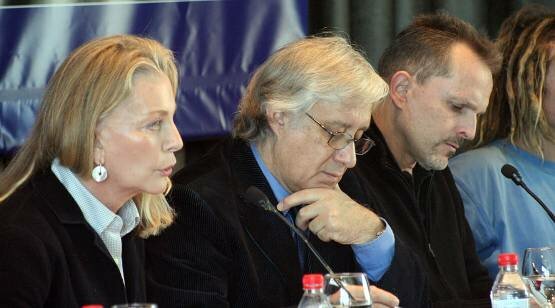
MarViva Founder and President, Erica Knie, speaks during the press conference presenting The End of the Line in Madrid, Spain. (From left to right), Knie, Oceana Europe Director Xavier Pastor, and artist Miguel Bose
The film examines the imminent extinction of bluefin tuna, brought on by increasing western demand for sushi; the impact on marine life resulting in huge overpopulation of jellyfish; and the profound implications of a future world with no fish.
Bose is the narrator in the Spanish version of the documentary, directed by Rupert Murray and based on investigative journalist Charles Clover’s book of the same name.
During the presentation, MarViva and Oceana released a statement signed by a group of environmental organisations and international figures urging Spain to support the ban on the international trade of bluefin tuna (Thunnus thynnus) at the next Conference of the Parties of the Convention on International Trade in Endangered Species of Wild Fauna and Flora (CITES) that will be held in Doha (Qatar) in March.
Representatives of Greenpeace, Ecologistas en Acción, Pew Foundation and the government of the Balearic Islands, and Roberto Mielgo (the former tuna farmer turned whistleblower who is a protagonist of the film) were present to support the statement.
They highlighted the critical situation that the species is undergoing in the North Atlantic and the need for immediate action to ensure its future. Decades of overfishing, illegal fishing and management dominated by industry interests, have decimated the bluefin tuna spawning stock to levels below 15 per cent of the existing population before industrial fishing.
Negotiations are currently taking place in the heart of the EU for a common stance for the CITES meeting, which will be a determining factor for this species’ future. The European Parliament’s Environment Committee, in a resolution within the process framework, has already urged Member States to support Monaco’s proposal for a ban on international trade.
The signatories consider that Spain has the responsibility of acting to preserve bluefin tuna, and they urge the Spanish government to immediately adopt and promote the following measures:
Support for the inclusion of bluefin tuna in Appendix I of CITES
Bluefin tuna is disappearing. The decades of management by the Contracting Parties to the International Commission for the Conservation of Atlantic Tunas (ICCAT), which include the EU, have been called an “international disgrace” [Report of the Independent Performance Review of ICCAT, 2008].
The parties have shown themselves to be incapable of adopting the necessary measures such as quotas in accordance with scientists’ advice or the closure of the fishery during the spawning period. CITES is currently the sole valid alternative to guarantee the future of this species.
On the other hand, the socio-economic considerations do not make sense in this context. The EU Member States must guarantee the fishing industry’s long-term viability. The administration’s current position only constitutes a guarantee that bluefin tuna fishing will cease to exist in the near future.
Spain, which currently holds the EU presidency and has the highest quota percentage among Member States, therefore has the responsibility of supporting this measure.
Creation of marine reserves in bluefin tuna spawning areas
The protection of bluefin tuna spawning areas in the Mediterranean through the creation of marine reserves is a necessary step to protect this species, starting with the area located to the south of the Balearic Islands where there is already sufficient scientific information that upholds the immediate need for protection.
The signatories include:
Organisations:
1. Palma Aquarium
2. PEW Foundation
3. Slow Food Spain
4. Slow Food Illes Balears
5. Greenpeace España
6. Avina
7. Ecologistas en Acción
8. WWF
9. Grup Balear de Ornitología (GOB) Mallorca
10. Grup Balear de Ornitología (GOB) Menorca
11. Grup Balear de Ornitología (GOB) Eivissa
12. Instituto Internacional de Derecho y Medio Ambiente (IIDMA)
13. Amics de la Terra Balears
14. Amigos de la Tierra Spain
15. Centro de Estudios Rurales y de Agricultura Internacional (CERAI)
International Public figures:
1. Kofi Annan, former secretary general, United Nations
2. Javier Solana, former High Representative of the European Union for the Common
Foreign and Security Policy
3. Michael Douglas, actor
4. José María Figueres, former President of Costa Rica
5. Sybilla, designer
6. Ted Danson, actor
7. Elle MacPherson, model
8. Basilio Baltasar, Director, Fundación Santillana
9. Dr. Enric Sala, investigative scientist of Consejo Superior de Investigaciones Científicas (CSIC) y Ocean Fellow, National Geographic Society
10. Diego Hidalgo, President, Fundación para las Relaciones Internacionales y el Diálogo Exterior (FRIDE)
11. Jordi Bigas, journalist
12. Diego Azqueta, Honorary President, WATU Acción Indígena
13. Sean Cleary, CEO, Strategic Concepts
14. Colin and Livia Firth, actors
15. Jordi Bigas, environmental journalist
16. Víctor Viñuales, Director, Ecología y Desarrollo
17. Pedro Barbadillo, director
18. Rupert Murray, director, The End of the Line
19. George Duffield, producer, The End of the Line
20. Charles Clover, investigative journalist, author of The End of the Line
21. Valeria Golino, actress
22. Baron Eric De Rothschild, banker
23. Greta Scacchi, actress
24. Stephen Fry, actor
25. Dr. Carles Amengual i Vicens, Education Secretary, Liga Médico Homeopática Internacional
26. Yannick y Ben Jakober, artists
27. Irene Peukes, designer
28. Sandy Hemingway, President, Amigos de la Tierra Spain
29. Liliane Spendeler, Director, Áreas Ambientales, Amigos de la Tierra Spain
30. Yolanda Kakabadse, former President, IUCN, and Senior Advisor, Fundación Futuro Latinoamericano
31. Prof. Jacques Marcovitch, former President, Universidad de Sao Paulo
32. Jaume Tapies, chef and President, Relais & Chateaux
33. Musaed Al Saleh, Council member, Earth Council Geneva (ECG)
34. Jacques Perrin, director and producer
35. Tom Aikens, chef
36. Sophie Andrieu, author
37. Joanna Lumley, actress
38. Charles Dance, actor
39. Fiona Shaw, actress
40. Zac Goldsmith, environmental journalist
41. Damian Aspinall, entrepreneur
42. Ben Elliot, entrepreneur
43. Ben and Kate Goldsmith, entrepreneur and envionromentalists
44. Laura Bailey, actress
45. Alan Rickman, actor and director
46. Prince Urbano Barberini, actor
47. Richard E Grant, actor
48. Sophie Dahl, writer and model
49. Emilia Fox, actress
50. Amber Valletta, actress and model
A crucial vote on whether Europe will back a trade ban on the critically-endangered bluefin tuna is expected to be taken on Tuesday.
In advance of the event, the makers of the film The End of the Line, which focuses on the over-fishing of the bluefin tuna in the Mediterranean, have sent an appeal to all 27 European Commissoners asking for them to watch the film and reflect carefully before making their decision. Continue reading ‘The End of the Line used in appeal to European Commission as crucial vote nears’
Copenhagen
As I dashed through the snow from the chaos around the COP15 climate conference to a screening of The End of the Line near the Town Hall in this lovely city, the phone went and I learned that European Ministers have done the right thing, arguably for the first time, in the annual talks over fish quotas, a story that might make headlines if it was not overshadowed by the climate talks.
They approved quotas based on scientific advice on North Sea cod, plaice and sole without discussion - instead of setting them at significantly more than scientists recommended as so often in recent years.
They also decided to ban fishing for the critically endangered porbeagle shark and cut allowable catches for the equally endangered spurdog.
What has come over them? Well partly it may have to do with an unprecedented spat with Norway over quotas, which will mean that these cannot be finalised until the New Year.
But I am also told that advisers have woken up to the fact that none of the major processers and retailers such as Birds Eye and Youngs are buying the North Sea cod because it is not being harvested sustainably.
Progressive ministers in Denmark, Germany and the UK have realised that the industry faces an uncertain future, and lower prices, unless it can sell its product across the whole market and this is behind the decision to bite the bullet, follow the scientific advice and manage the fishery properly. This is not before time, but to be applauded.
Could this have had anything to do with the fact that The End of the Line has been screened recently in all those countries?
Well, probably not directly, but indirectly the message that we in Europe can’t go on managing our seas like this seems to be getting through.
The End of the Line was shown in remarkable circumstances this week – in the official convention hall of a hotel near Recife, Brazil, where the world’s oldest whole-ocean fisheries management organisation was meeting to set controversial catch limits for the Atlantic’s dwindling populations of tuna, swordfish and sharks.
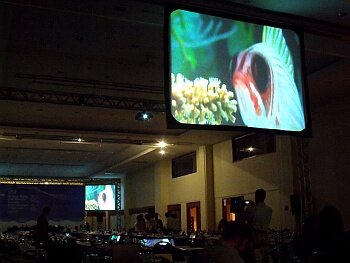
The End of the Line is shown at the International Commission for the Conservation of Atlantic Tunas meeting in Brazil
It took a certain amount of persuasion. It needed the crucial backing of the Brazilian chairman of the meeting, Prof Fabio Hazin (the curiosity of these meetings is that the chairmen are usually enlightened while the contracting parties from the fishing nations, which include Libya, are anything but).
It also needed a mysterious process of agreement from heads of delegations sitting in closed session.
The chief scientist, Dr Gerald P Scott, an American, was consulted, and pronounced in a neutral kind of way that the idea of showing a film, after and outside the official business of the day, was something that had been done before - though quite when nobody could remember - and might provide an opportunity some delegates might not otherwise get to see it. The film was duly shown in the convention centre, on official equipment.
Was this a sign that the dysfunctional International Commission for the Conservation of Atlantic Tunas – often known to its critics as the International Conspiracy for Catching All The Tuna – was at last beginning to listen to voices outside the fishing industry, such as the citizens who actually pay them to manage the sea? No one could say for sure.
About 40 people postponed their need for a beer or managed to slip out of meetings to see the film. Some of these, inevitably, were the already converted: conservationists who were seeing the film as an act of solidarity with its message.
Two Asian delegations stood around talking before filing out. But here and there, as you looked around, were some senior delegation folk sitting in small groups including, significantly, most of the Spanish delegation. At the end, there was applause.
We were approached the next night by the secretariat requesting a second screening for delegations, principally Mexico, that had missed the screening we had organised because of meetings. So we were back by popular demand.
Could the message be getting out that our seas are a mess and ICCAT has failed for 40 years to tackle the problem of the depleting Atlantic ocean?
Whether or not this was a sign of changing times, for once this week the message got through.
Ends
The movie that changed the way people think about what’s on their dinner plate makes its TV debut tonight – Tuesday October 20.
The End of the Line film was being screened by More4 at 10.00pm and is the latest stage of its incredible journey.
Among its many other milestones is an unprecedented four week run in London’s West End, a screening at the Sundance Festival and dozens of special screenings at subsequent festivals.
There have also been special screenings for European royalty including Prince Albert of Monaco and the Queen of Spain.
It was on screen as the UK’s first online seafood restaurant guide www.fish2fork.com was launched this week with the backing of some VIP supporters.
Sarah Brown, the Prime Minister’s wife, said on Twitter: “The End of the Line, the brilliant, watchable film on fish is on More4 at 10.00pm tonight and sustainable fish restaurant guide www.fish2fork.com”.
There was a similar message from author, actor and green activist Stephen Fry, who urged his 870,000-strong army of followers to watch the film and to visit the website.
Fish2fork.com aims to rate restaurants not just on the usual criteria of how good their seafood is but perhaps, more importantly, on what impact its capture has on our oceans and marine life.
The online guide has been set up by the same team which turned Charles Clover’s book The End of the Line on over fishing into a hugely powerful film.
Visitors to the site will find information about seafood restaurants across the UK and will be encouraged to ask questions about the fish they are offered when they dine out.
They can then easily upload their own view of the restaurant’s commitment to sustainability onto the website and help give it a simple rating score - blue fish for good and red fish for bad – on a sliding scale.
For its launch the website has reviewed and rated more than 100 restaurants across the UK but is relying on diners to provide their own reviews and help the website grow into an authoritative reference guide.
Within hours of its launch the website was being contacted by fish lovers eager to get involved by nominating restaurants they want to see in the guide.
Fish restaurants were also quick to see the marketing possibilities of being featured on the site and had filled in the www.fish2fork.com questionnaire.
The UK’s first online seafood restaurant guide – www.fish2fork.com – is launched today.

Fish2fork is the UK's first online seafood restaurant guide
The interactive guide aims to rate restaurants not just on the usual criteria of how good their seafood is but, perhaps more importantly, on what impact its capture has on our oceans and marine life.
Visitors to the site will find information about seafood restaurants across the UK and will be encouraged to ask questions about the fish they are offered when they dine out.
They can then easily upload their own view of the restaurant’s commitment to sustainability onto the website and help give it a simple rating score - blue fish for good and red fish for bad – on a sliding scale.
Fish2fork.com, run by the same people who produced The End of the Line, has reviewed and rated more than 100 restaurants initially but is relying on diners to help the website grow into an authoritative reference guide.
Among those who scored bottom in the guide, denoted by five red fish skeletons, included J Sheekey, the restaurant owned by the company that also owns the Ivy and the Caprice, and Nobu, the Japanese fusion chain. Rick Stein, the TV chef, rated half a red fish skeleton, which indicated he served several “fish to avoid.”
The Loch Fyne chain and the Michelin-starred Hibiscus in London’s West End scored joint highest with three blue fish.
The website’s aim is not to persuade people to stop eating fish – quite the contrary – it wants everybody to continue enjoying seafood. But the world’s fish stocks are under pressure like never before and if future generations are to share the same privilege, old habits have to change.
As fish2fork.com editor Charles Clover, revealed in his book on which The End of the Line film was based, as many as 80 per cent of the world’s fish stocks are fully or over-exploited and some fish species, such as the bluefin tuna or the beluga sturgeon, are now listed as critically endangered.
The cavalier attitude to our oceans and the seafood they contain has to change if the appalling prospect of a world without fish is to be avoided. And diners, by making the right choices about the fish they eat, have a powerful economic weapon they can use in bringing about that all-important change.
Fish2fork.com has been set up specifically to help diners make informed decisions before they visit a seafood restaurant on which strive to provide the most sustainable fish to eat and which serve mostly fish to avoid.
Using the International Union for Conservation of Nature (IUCN) Red List and the Marine Conservation Society (MCS) list of species to avoid, the website earlier this summer benchmarked the menus of more than 100 restaurants. They were then contacted and asked to complete a questionnaire so that a rating could be given.
The questions were designed to assess a restaurant’s sourcing policy, for instance, whether it offered wild or farmed fish, whether its shellfish were dredged or whether it offered species of fish which were either endangered or under threat because of over-fishing.
Where a restaurant declined or was unable to complete the questionnaire it was filled in by fish2fork.com staff using its online menu as a source of information.
The survey produced some startling results:
- Almost 90 per cent of restaurants are serving at least one “fish to avoid” species.
- Some Michelin-starred restaurants were amongst the worst offenders and a quarter of those surveyed are serving fish regarded as endangered.
- More than one in three restaurants served three or more species from the “fish to avoid” list.
Charles Clover, the editor of fish2fork.com, said: “Some restaurants still have not grasped that sustainability is now part of the definition of good food. You don’t want to eat a wonderful meal and have nightmares about the species you have pushed a little further towards extinction.
“This new guide shows the wonderful work some chefs and proprietors are doing with fishermen to make sure that they source fish of the highest quality caught in the most selective ways.
“It also shows the awful dark side of gastronomy, chefs who place an ephemeral taste for which they can charge the Earth above the survival of whole species and ecosystems.
“What few people know is that the supermarkets have made huge strides in recent years to get endangered fish off their shelves.
“The trouble is, these species very often remain on the menu at white tablecloth restaurants who haven’t yet had the searchlight of public opinion directed at the dark corners of their menus, where there are some real horror stories.”
Willie Mackenzie, oceans campaigner for Greenpeace UK, said: “As consumers we all have an impact on the oceans every time we eat a forkful of fish.
“We can make a real difference by what we buy, and we need to hold the retailers and restaurateurs to account for their fish sourcing policies. If we want to eat fish in years to come, then we have to radically overhaul the way we are fishing today – and your fork is the front line.”
Sam Wilding, the Marine Conservation Society’s fisheries officer, said: “It is encouraging to see Fish2fork highlighting the issue of seafood sustainability to restaurants and chefs, and giving the concerned consumer a voice.
“MCS provides consumers with free advice on seafood sustainability, through our pocket good fish guides and fishonline.org and is pleased to see our advice incorporated into the Fish2Fork campaign.”
Visitors to fish2fork.com can download the same questionnaire used in the survey to rate their own restaurant. Alternatively, they can ‘rat’ on a restaurant they suspect of malpractice, or ‘pat’ a restaurant they think deserves recognition by sending a quick email.
The website also features a ‘widget’ which will enable visitors to look up and check the conservation status of most species of fish they are likely to encounter in a restaurant.
For more information go to www.fish2fork.com.
The End of the Line supporter Prince Albert of Monaco appeared on Channel 4 News discussing the proposal to add bluefin tuna to CITES - The Convention on International Trade in Endgangered Species.
It’s de rigueur in some quarters to dismiss France jokingly, as the Simpsons and some US political-types famously have done in the past. But the news today from Brussels suggests that the French government have made an embarrassing volte-face on bluefin tuna.
Just two months ago, none other than President Sarkozy himself announced that France would back a ban on international trade in Atlantic bluefin tuna. This was huge news, as one of the principal fishing countries for the species, no one had thought they would take this position. This meant supporting the listing of the species under CITES, as is already the case for similarly-threatened species like rhinos, tigers, and gorillas. None of which, of course, are lucrative for big business or in high demand as delicious sushi.
France’s backing for a ban was promptly followed by the UK , Netherlands , Germany , Austria and Poland , all of them lining up to endorse the proposal by Monaco (the world’s first bluefin-free country). Amidst a flurry of media pressure, celebrity lobbying, and the influence of the End Of The Line, it seemed that bluefin had become a cause célèbre … and there was much rejoicing when the European Commission added its weight to the call for a ban just ten days ago.
So – just what has happened today? Well in order for the EU to back the proposal (and all 27 Member States would be bound by this) they needed to get a ‘qualified majority’ of 75%, effectively representing three quarters of the EU’s population. Because large and populous countries like France , Spain and Italy have voted against the proposal – there is in effect no agreement.
That means the decision will pass to Environment ministers from each of the EU member states at a later meeting, and it means that for all the press-posturing, none of the EU countries, or the EU itself, can co-sponsor Monaco ’s proposal to make a ban on the international trade in bluefin a reality.
Undoubtedly there has been fervent lobbying behind the scenes, by those with a vested interest, from the EU and beyond. And we know, too, that the ineffectual and shambolic Management Organisation ICCAT, currently tasked with looking after Atlantic bluefin, is desperate not to cede control to CITES. But we also know that others are wising up to the situation, with Mitsubishi Corporation last week reiterating its own concerns over the state of Atlantic bluefin.
So, as well as possibly being an embarrassing day to be European, today is not a good day to be a bluefin tuna – with reports surfacing just last week of the failures of enforcement and ever more illegal fishing of this beleaguered species.
As they say in France , plus ça change.
On 17th September The End Of The Line became only the second film ever to be have a screening at No. 10 Downing Street – a very special event hosted by the Prime Minister’s wife, Sarah Brown.

Willie MacKenzie and Claire Lewis outside Number 10, before the screening of The End of the Line
The specially-invited audience was an eclectic mix of individuals, ranging from people working in the media, to NGOs, restaurateurs, representatives of the fishing industry, and some sixth-form students too.
Indeed Sarah Brown joked that many people were confused as to why they had been invited.
The UK’s Fisheries Minister, Huw Irranca-Davies was there, and both he and Sarah Brown told the assembled crowd just how important and essential they think the film is, and Charles Clover and Executive Producer Chris Gorell-Barnes were also able to say a few words on the issues.
This was a great opportunity, not only for the obligatory photos by the famous door, but also for reaching out to new audiences with the film’s message.
Sarah Brown has been a big supporter of the End Of The Line since attending the screening at the Science Museum earlier this year, and it is with the support of many such individuals that the film has managed to cross over and reach parts other documentaries can’t reach!
As well as the opportunity to see the film, the event was a great forum for the film team, and us fish-hugging NGO-types to talk about the issues in an informal setting with some people who really can help make a difference. The impressive surroundings helped too of course.
It’s rare, for example to get some unfettered access to chat with a government minister, and it’s also great to be able to talk to people fresh from their first viewing of the film about what are the most relevant and pressing things we need to do now.
It would be no exaggeration to say that bluefin was the hot topic on everyone’s lips (and thankfully I’m not referring to the catering).
The urgency of the plight of bluefin is something that we can’t ignore – and it’s something that we must give the UK government some kudos for, as they seem to be taking a very strong international lead on calling for a ban on the international trade in the species.
Thursday night’s screening was a chance for some supporters, notably the glamorous and eager bluefin-defender Greta Scacchi, to get a sense of how they can help at an international level, and for us to forge relationships with some of the people making the decisions, and others keen to help spread the message
And this is, of course, very timely too. Next week will see a crucial meeting when (we hope) EU member states agree to back the European Commission’s proposal for a ban on bluefin trade.
We see in Thursday’s Guardian yet another expose of rampant illegal fishing for bluefin tuna… and we must do whatever we can to make Europe and the rest of the world wake up to the need to take action.
The end of the line? Is this a film or an echo of the thoughts in my mind, somehow captured and recorded to be played to those that are prepared to listen to the truth that is unfolding all around us.
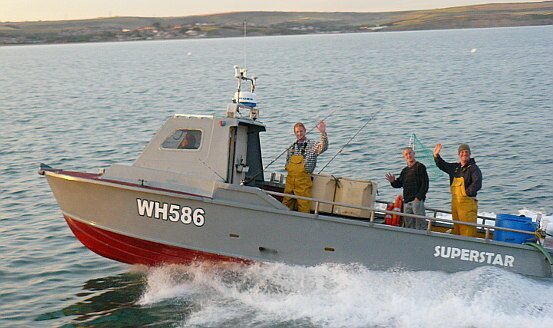
Fishermen from Portland Sea Bass company
My name is Jason Hemmings, I am the managing director of a fishing company, Portland Sea Bass Ltd, that catches and sells seafood that is fished in a sustainable manner - by rod and line - direct to the customer.
We also dive for scallops picking each one individually from the sea floor whilst leaving their surroundings intact and unharmed.
I was invited to a screening of The End of the Line at which Claire Lewis, one of the producers of the film, was doing a question and answer session afterwards.
I would like to say that it was an eye opener but as a commercial fisherman I am all too aware of what is happening in our oceans and see the story unfolding in front of me every day.
I have only been a fisherman for three full years, this is my fourth, our main target species is the European Sea Bass. Currently this is not a pressured stock but in the not-too-distant future, it may well be.
If the fishing methods that are used to catch these fish by other fishermen, such as pair trawling, are not stopped, if politicians continue to ignore what they have paid their scientists good money to undertake and understand, if the policing of illegal fishing is not funded or they are not given the power to do anything about illegal fishing, if reserves are not set up, if closed seasons when fish are breeding are not introduced then the Sea Bass will go the same way that the rest of the fish are going - fish heaven. Which would be hell for all of us that depend on them for our livelihood.
We need to harness them not just harvest them.
Politicians find it hard to come up with solutions, they have to think about commerce - which is destroying our planet. They always act too late and the longer they leave it, the more the costs spiral and the less financially viable the solutions become.
Sometimes in politics dictators are needed just enough to get us back on the right tracks, so we can “do the right thing!” The dictator is… yep… that’s right… little old wise… you.
Start buying fish that is fished by sustainable methods, don’t buy fish that is endangered, buy fish that have finished their breeding season and are in season, so to speak.
Buy fish that belong to an accredited fishery. Ask where your fish comes from and what fishing method was used. If the person selling the fish doesn’t know, then don’t buy it.
If you stop buying fish and fish products that are not harvested in a sustainable manner, then the person catching them will not be able to sell their fish, their operation will not be profitable, they will either put their good head on and fish sustainably or go out of business.
If you stick to your guns you can make it happen. Don’t give in, be powerful, be part of it, be strong play your trump card and win.
You are trumps and the line is in your hand! What is at the end of it?
Charles Clover, author of The End of the Line, appearing on Channel 4 News on the likelihood of a ban on bluefin tuna fishing.